

 Visit our Showroom
Key Findings
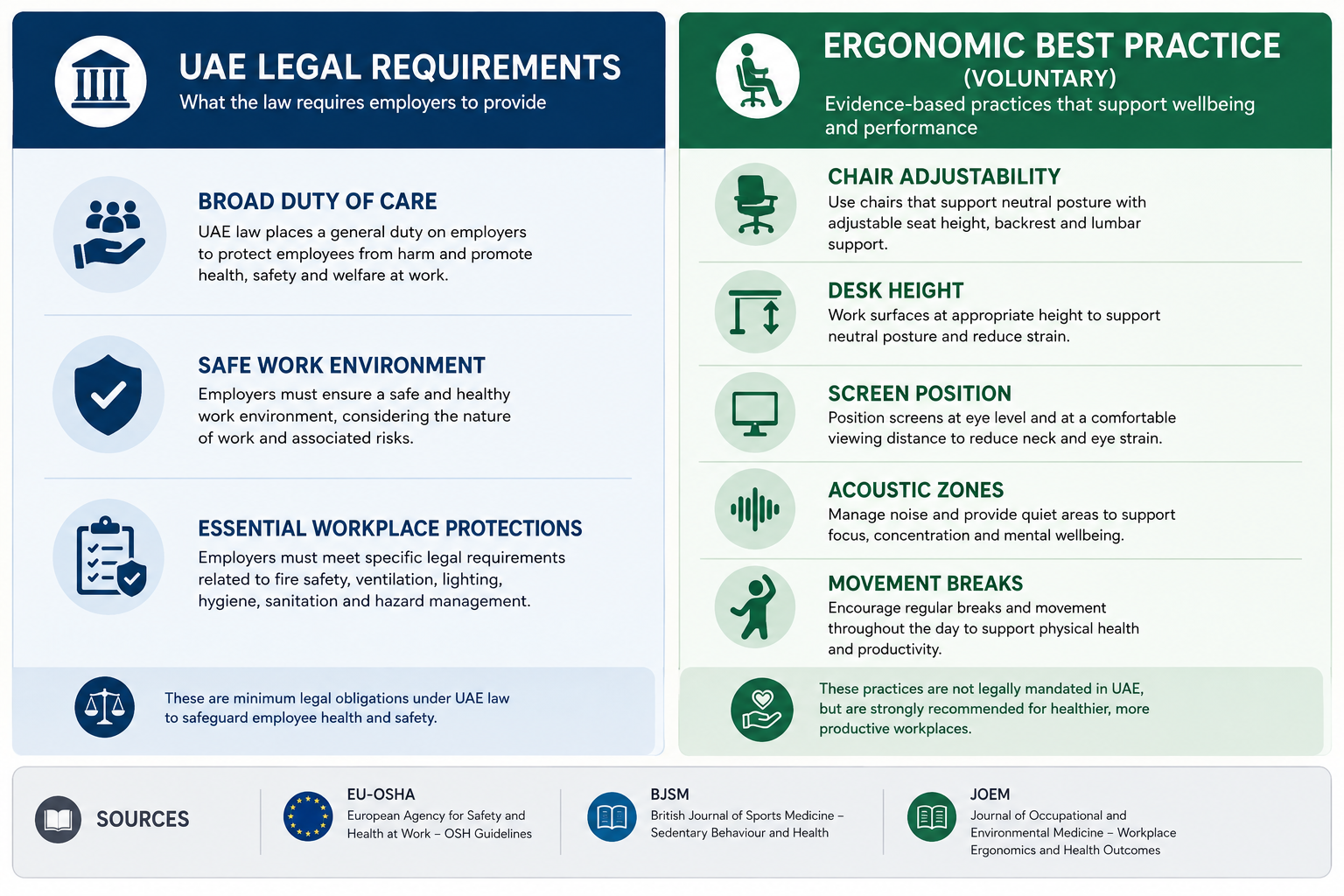
*Federal Decree-Law No. 33 of 2021 establishes a broad employer duty to provide a safe work environment — it does not mention ergonomics, specific furniture types, or chair adjustability.
*UAE law does not legally require BIFMA-certified chairs, standing desks, adjustable monitor arms, or acoustic pods.
*MoHRE workplace inspections focus on fire safety, emergency exits, ventilation, lighting, and hygiene — not desk height or armrest type.
*BIFMA is a voluntary American trade standard; OSHA is a US government agency; WELL is a private voluntary certification — none carry legal standing in the UAE.
*Ergonomics is a recognised best practice for employee health, productivity, and comfort — supported by international research but not mandated by UAE legislation.
*Employers who invest in ergonomic workspaces may reduce absenteeism, lower musculoskeletal complaint rates, and improve staff retention — the business case is real even where the legal mandate is not.
Take me to
What UAE Law Actually Requires
Federal Decree-Law No. 33 of 2021 — the UAE Labour Law — establishes a broad duty of care under Article 13. Employers must provide a safe and appropriate working environment, protect workers from occupational injuries and diseases, and comply with occupational health and safety requirements set by MoHRE and other competent authorities.
This is genuinely important legislation. But it sets broad principles — not specific furniture specifications. The law does not mention ergonomics, sitting posture, desk height, chair adjustability, or any particular product standard. It creates a framework within which employers must operate safely. What "safe" looks like in a specific workplace is determined by context, not a prescribed product list.
Cabinet Resolution No. 1 of 2022 implements these principles through specific OSH obligations — risk assessment, safety training, hazard management, appropriate lighting, ventilation, and hygiene standards.
What MoHRE workplace inspections actually cover:
Emergency exits and fire safety compliance
Adequate lighting and ventilation
Hazard signage and safety protocols
Basic hygiene standards
General physical workplace safety
MoHRE inspectors do not audit desk heights, armrest types, lumbar adjustment mechanisms, or chair certification standards. A company using standard 75cm fixed desks and basic office chairs is not violating UAE Labour Law, provided the workplace meets the general safety, lighting, ventilation, and hygiene requirements above
Where Voluntary International Standards Fit In
BIFMA, OSHA ergonomic guidelines, and the WELL Building Standard are not UAE legal requirements. They are voluntary international frameworks - each originating outside the UAE - that define best practice for workplace ergonomics, furniture quality, and building wellness.
Understanding what each actually is prevents the common mistake of treating them as equivalent to UAE law:
BIFMA (Business and Institutional Furniture Manufacturers Association): A voluntary American trade association that publishes quality and safety standards for office furniture. BIFMA certification means a product has been independently tested against those standards. It has no legal standing in the UAE. A MoHRE inspector will not ask for BIFMA documentation. It is, however, a useful quality signal when purchasing furniture — indicating independent structural testing rather than manufacturer self-rating.
OSHA Ergonomic Guidelines: Published by the US Occupational Safety and Health Administration - a US government agency whose regulations apply only in the United States. OSHA's computer workstation guidelines are well-researched and practically useful as a reference for neutral posture requirements. They are not UAE law and create no legal obligation for UAE employers.
WELL Building Standard: A private voluntary certification programme focused on building health and wellness. Relevant for organisations pursuing green building certification or ESG reporting frameworks. Not a UAE regulatory requirement.
The honest framing: These frameworks exist because there is substantial evidence that ergonomic workplaces reduce musculoskeletal disorders, lower absenteeism, and improve sustained productivity. They codify best practice - not legal minimums. UAE employers can reference them voluntarily to build healthier workspaces. No UAE authority will penalise an employer for not following them.
Why Ergonomics Still Makes Strong Business Sense
Setting aside what the law requires, there is a compelling independent business case for ergonomic workspaces in UAE offices — grounded in research, not regulation.
Musculoskeletal disorders are the most common occupational health issue globally, according to EU-OSHA research. They result in absenteeism, reduced afternoon productivity, physiotherapy costs, and in chronic cases, longer-term incapacity. In Dubai and GCC offices running 8–10 hour days, the daily accumulation of postural load from poor seating and incorrect desk height is a genuine operational risk - even where it creates no specific legal liability.
The productivity impact is documented. Research published in the Journal of Occupational and Environmental Medicine found employees using well-designed ergonomic workstations achieved meaningfully higher productivity. The mechanism is direct: physical discomfort competes for cognitive resources and reduces the mental capacity available for work.
The talent retention dimension is real. Research shows a significant proportion of employees consider office environment quality when evaluating employers. In Dubai's competitive talent market, a workspace that causes daily discomfort is a retention risk - even if it creates no legal liability.
The investment is modest relative to the cost of not making it. A quality ergonomic chair lasts 8–12 years with proper maintenance. Amortised across that period, the per-year cost is lower than a single physiotherapy session for back pain. Employers don't need a legal obligation to make this calculation work in their favour.
What Good Ergonomics Actually Looks Like in Practice
The research-supported principles for office ergonomic best practice — none of which are UAE legal requirements, all of which may support a healthier and more comfortable workplace:
Seating: Chairs that adjust to accommodate different users — seat height range wide enough to serve your team's height distribution, lumbar support that can be positioned at each user's spinal curve, and armrests that don't force shoulder elevation. These adjustments matter more in shared or hot-desk environments where multiple users of different heights use the same chair.
Desk height: The ergonomic target is keyboard at elbow height when sitting naturally — approximately 68–75cm for most adults, varying with height. Standard desks at 75cm serve users in a narrower range correctly; height-adjustable options serve a wider range. For offices serving internationally diverse UAE teams, adjustability provides more consistent ergonomic outcomes. This is a recommendation based on research, not a legal requirement.
Screen position: Monitor top at or near eye level, 50–70cm from face, is the internationally recommended position for reducing neck strain. A monitor arm achieves this more precisely than a fixed desk stand. Not required — but consistently beneficial for users spending 6+ hours at screens.
Acoustic environment: Open-plan noise in hybrid offices with heavy call volume creates measurable cognitive load. Research in Occupational and Environmental Medicine links sustained noise to reduced accuracy and elevated cortisol. Acoustic pods and phone booths address this. No UAE law mandates them — but the productivity and wellbeing case is independently strong.
Movement: Regardless of furniture, regular position changes — sit-stand alternation, microbreaks, brief movement — reduce static postural load. The British Journal of Sports Medicine recommends at least 2 hours of standing or movement across an 8-hour workday. This is health guidance, not UAE law.
The Practical Employer Position
UAE employers have two distinct obligations operating at the same time — and understanding which is which prevents both over-compliance (buying furniture under false legal pressure) and under-investment (ignoring genuine business reasons for better workspaces).
Legal obligation: Provide a safe work environment meeting general OSH standards under Federal Decree-Law No. 33 of 2021. Document risk assessments. Maintain fire safety, ventilation, lighting, and hygiene standards. Comply with MoHRE requirements. This is the legal floor.
Business judgement: Beyond the legal floor, ergonomic investment — adjusted seating, appropriate desk heights, acoustic management — may reduce absenteeism, improve productivity, support talent retention, and contribute to a workplace culture that attracts good people. This is not the law. It's a business decision with a well-evidenced case behind it.
The distinction matters because conflating the two leads to poor decisions in both directions. Employers who believe ergonomics is a legal requirement may feel coerced into specific product purchases that don't actually serve their team best. Employers who dismiss ergonomics because it isn't legally required may miss the genuine operational and human benefits of a better-designed workspace.
The right question isn't "what does UAE law require us to buy?" It's "what does our team need to work well, and what investment in that workspace makes business sense?"
A Practical Employer Checklist: Demonstrating Good Faith on Workplace Ergonomics
UAE law doesn't specify ergonomic furniture standards. But it does require employers to demonstrate an active, documented approach to worker health and safety under Federal Decree-Law No. 33 of 2021 and Cabinet Resolution No. 1 of 2022.
The following steps don't create legal obligations beyond what already exists — but they demonstrate that an employer has thought about employee health, taken reasonable steps, and documented their approach. That matters if a musculoskeletal complaint is ever raised formally.
✓ Conduct and document a basic workplace risk assessment Identify physical risks in the office environment — including sustained sedentary work, lighting adequacy, ventilation, and noise levels. Document findings and any control measures taken. This is already required under Cabinet Resolution No. 1 of 2022 for all workplaces — the gap in most offices is that it hasn't been done or hasn't been updated since original fit-out.
✓ Provide basic ergonomic orientation to new employees A 15-minute induction covering how to adjust their chair, set screen height, and position keyboard correctly costs nothing and demonstrates the employer has taken active steps toward worker comfort. Document that it happened.
✓ Respond to musculoskeletal complaints in writing If an employee raises a back pain or posture-related concern, document that it was received, assessed, and addressed — even if the response is a chair adjustment or desk height check rather than a furniture replacement. An undocumented complaint followed by no action is the liability risk, not the complaint itself.
✓ Verify basic seating adjustability across the office Chairs don't need to be BIFMA-certified to be adequate. But they should adjust — at minimum seat height — so each employee can set their feet flat on the floor and elbows at desk level. A chair that has no adjustments at all for a diverse team is harder to defend under a broad duty-of-care argument.
✓ Check lighting and screen glare UAE OSH standards reference adequate workplace lighting. For screen-based work, this includes positioning monitors away from direct window glare and ensuring ambient illumination is sufficient. This sits within the legal framework — and is often overlooked in Dubai offices with floor-to-ceiling windows.
✓ Review annually or after significant layout changes A risk assessment that hasn't been updated since the original fit-out doesn't reflect the current workplace. Hybrid work, team growth, and floor reconfigurations all change the risk profile. Annual review is a reasonable standard.
What this checklist is not: a guarantee of legal immunity, a requirement to purchase specific furniture, or a substitute for formal legal advice. If your organisation operates in a regulated sector with specific workplace health requirements — healthcare, construction, manufacturing — consult a UAE-qualified occupational health specialist.
Why invest in ergonomic furniture if it's not legally required?
The business case is independent of legal obligation. EU-OSHA research identifies musculoskeletal disorders as the leading occupational health issue globally - with documented costs in absenteeism, reduced productivity, and staff turnover. The investment in better workspaces can pay for itself through these avoided costs, regardless of whether UAE law requires it.
Need Help Building Your Ergonomic Setup?
We'll guide you to the perfect chair, desk setup, and comfort tips for a productive workday.
Shop Office FurniturePopular Blogs
View all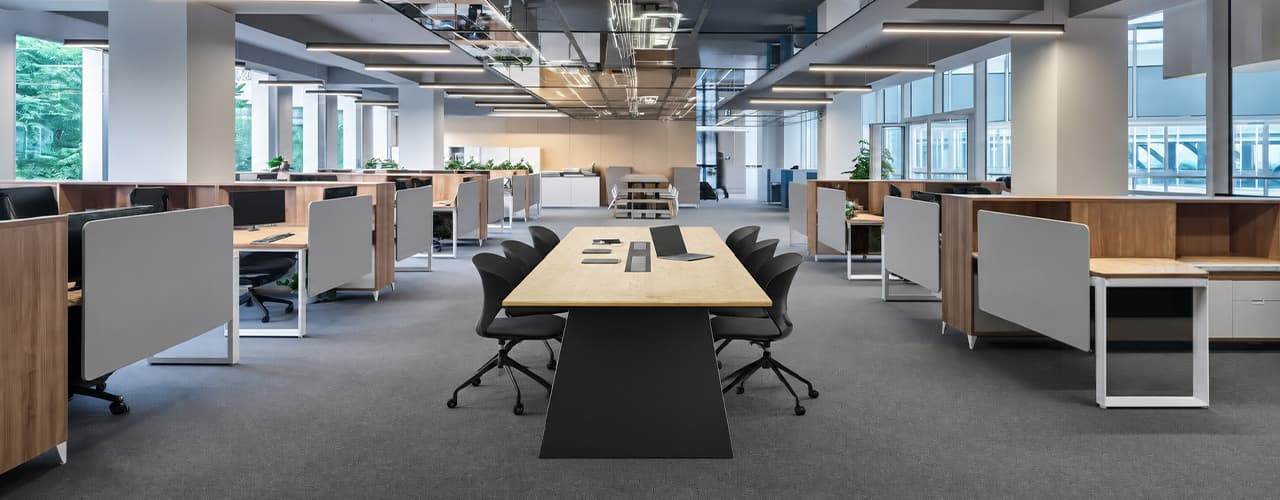
Open Plan vs Cubicle vs Hybrid Office Layout: Which Is Right for You?
The open-plan office was supposed to fix everything the cubicle farm got wrong. It didn't. It created a different set of problems and left people nostalgic for the one thing cubicles did well: quiet. The hybrid layout is positioned as the solution that addresses the shortcomings of both. It might be only if it fits how a specific team works. It shouldn't be a mix of two philosophies that didn’t help the team before. This guide shows what each layout offers and where it falls short. It also helps you choose the best option-or combination-for your office in Dubai or the GCC.
Key Findings
*Global office use is now at 53%, up from 38% in 2024. Also, 69% of teams have over 40% of their staff sharing desks. This shows that 2019 workspace designs don’t fit current needs.
*A Harvard study found that open-plan spaces often lower face-to-face interaction. Instead, they boost digital communication. This is the opposite of what these designs aim for.
*A hybrid model conversion at a 120-person SaaS company restored engineering deployment speed to baseline. It also reduced voluntary turnover in technical roles by 18% over nine months.
*Steelcase research shows that companies improving their work environment boost productivity by 17%.
*In 2026, the most innovative UAE offices aren’t just picking open plans or cubicles. They’re creating “activity neighborhoods.” These are clusters of spaces designed for different work styles.
*No layout is universally right. The best choice depends on your team's work style, industry, hybrid attendance ratio, and specific acoustic needs for your floor.
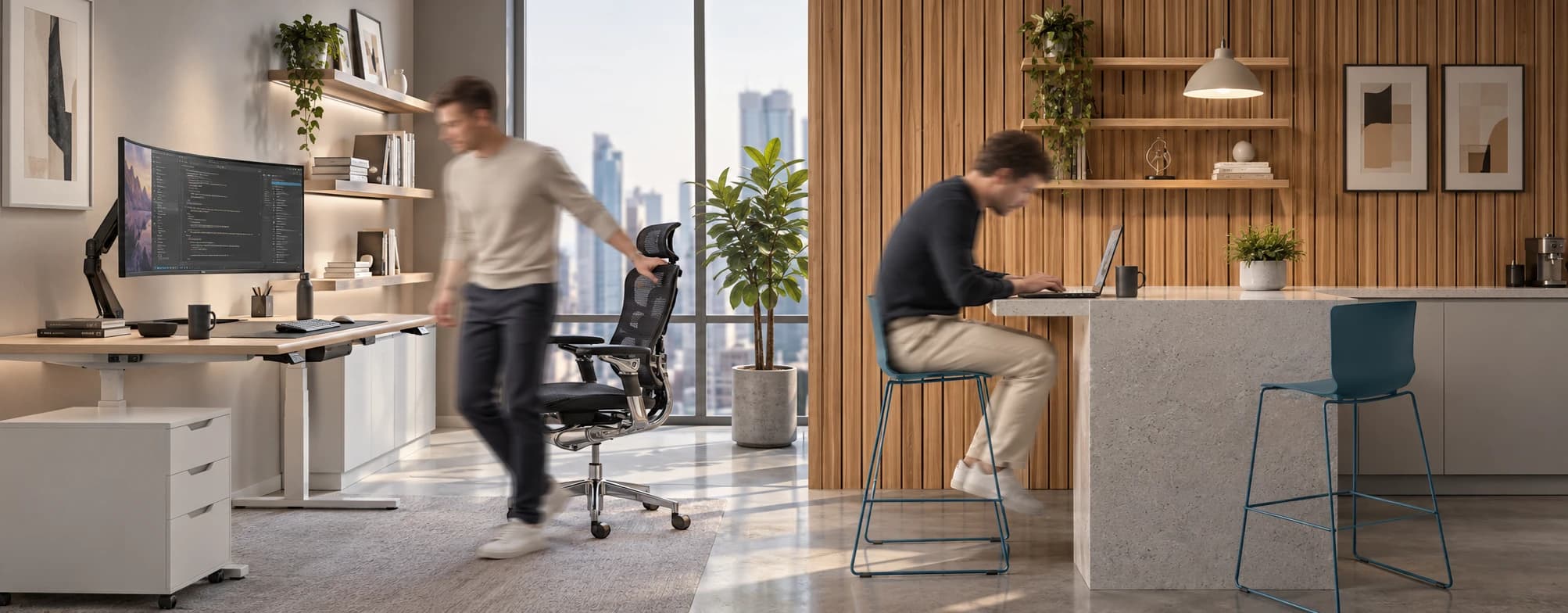
Sitting isn’t the Enemy, How You Sit Is: How to Align Your Desk for Zero Back Strain
If your job keeps you at a desk for most of the day, you are not alone—and you are not stuck. Software developers and data entry keyers spend 100% of a typical workday seated, while financial managers sit for 94%. Sitting is a standard part of modern work, so the real goal is learning how to reduce its physical impact while staying productive.
What the Research Shows
*Sedentary Volume: Adults in high-income countries spend 11–12 hours daily sitting over 75% of their waking hours (British Journal of Sports Medicine).
*Cardiovascular Risks: Sitting 6–8 hours daily increases cardiovascular event risk by 125% to 150% (Mayo Clinic).
*The 22-Minute Counter: 22 minutes of daily moderate-to-vigorous activity (brisk walking, cycling, active housework) offsets the mortality risk of prolonged sitting (BJSM).
*Micro-Break Impact: 5-minute movement breaks every hour significantly reduce fatigue and improve mood without hurting work performance (2026 BJSM Study).
*Gym Fallacy: A 60-minute workout in the morning does not fully reverse 9 hours of continuous sitting; daily movement breaks are still required.
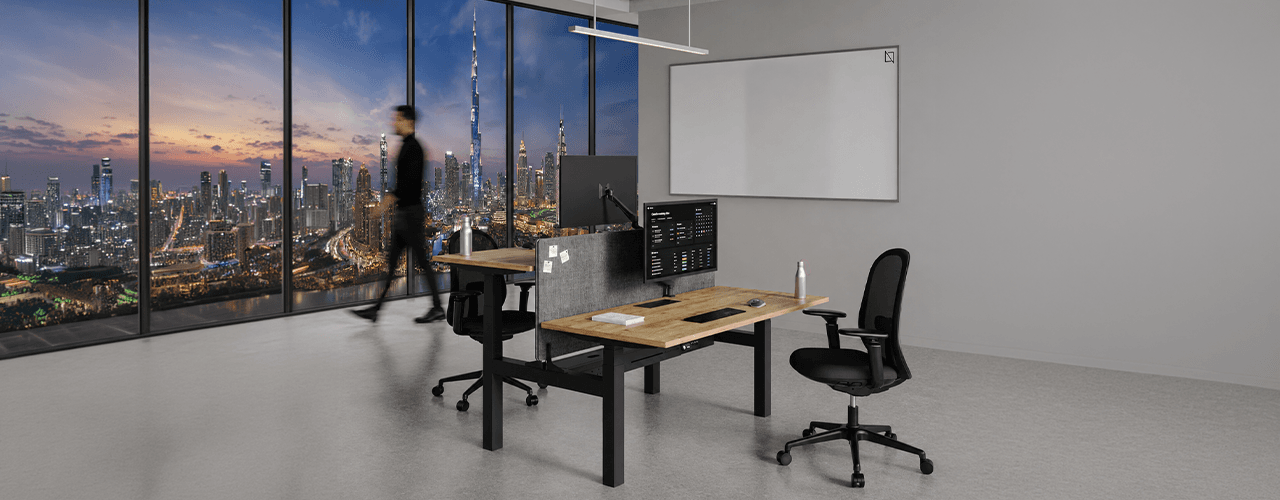
The Ultimate Office Furniture Setup Checklist for Modern Teams
Most offices aren't badly furnished. They're incompletely furnished. A great chair paired with the wrong desk height. A standing desk with no monitor arm. A collaborative floor with no acoustic separation.
The gap is rarely one big thing. It's several small things missing from the same setup at the same time.
This checklist covers every furniture category a modern UAE office needs — what to look for, what to avoid, and what the research says about each. Use it for a new fit-out, an upgrade review, or a department-by-department audit.
Key Findings
*The chair is the top furniture investment for knowledge workers. It has the most contact hours and directly impacts posture, energy, and afternoon performance.
*Fixed desks at 75cm fit about 30–40% of UAE office teams well. Height adjustability isn’t a luxury; it meets everyone’s needs.
*Open-plan offices without acoustic zones can lose employees up to 86 minutes of productive time each day. This is based on workplace productivity research.
*EU-OSHA highlights musculoskeletal disorders as the top workplace health concern worldwide. Poor seating and desk height are key factors.
*CBRE's 2026 Global Workplace Insights reveals that 69% of organizations have over 40% of staff sharing desks. This shift means adjustability is now a standard requirement, not just an upgrade.
*Quality ergonomic chairs last 8–12 years. A BIFMA-certified chair costs less per year when spread over 10 years. This cost is lower than one physiotherapy session for occupational back pain in Dubai.
You x Navo
Feel free to reach out to us for any queries & concerns