

 Visit our Showroom


An office relocation is one of the few times a business can reset everything at once. New floor plan. New layout. New specification. The team is already disrupted - use that disruption productively.
Most businesses don't. They move the existing furniture into the new space, recreate the same ergonomic problems in a different postcode, and wonder why the new office feels exactly like the old one within six weeks.
Since 2019, we've been supplying and installing office furniture in the UAE, Saudi Arabia, Qatar, Kuwait, Bahrain, and Oman - coordinating deliveries to new fit-outs, advising on what's worth moving and what isn't, and helping businesses treat a relocation as a genuine reset rather than an expensive shuffle. This checklist is what we'd walk you through.
Key Findings
* The most common office relocation furniture mistake is moving everything from the old space — including furniture that wasn't working ergonomically — rather than using the move as a reset opportunity.
* Lead times in the UAE are product-specific: standard stock chairs arrive in 1–2 weeks; custom-finish standing desks and pods can take 4–8 weeks. Failing to account for this leaves teams working from boxes for weeks after move-in.
* A BIFMA-certified Office chair that is 4–5 years old with all mechanisms functioning is worth moving; foam-compressed, non-adjustable chairs from the same era are not. The distinction is functional condition, not age.
* The new floor plan should drive furniture decisions — not the other way around. Furniture specified before the floor plan is confirmed creates costly changes.
* Freestanding acoustic pods and phone booths are furniture, not construction — but permit requirements depend on the specific installation and local authority rules. Confirm requirements before proceeding.
* An office relocation is the best opportunity to correct ergonomic specification mistakes: desk heights, chair adjustability, monitor positions, and acoustic zoning are all easier to fix at move-in than six months after.
Take me to
Step 1: Audit Before You Pack - Not After
The first furniture decision in any office relocation is what comes with you. Make it before a single item is boxed, not on moving day when every decision is time-pressured.
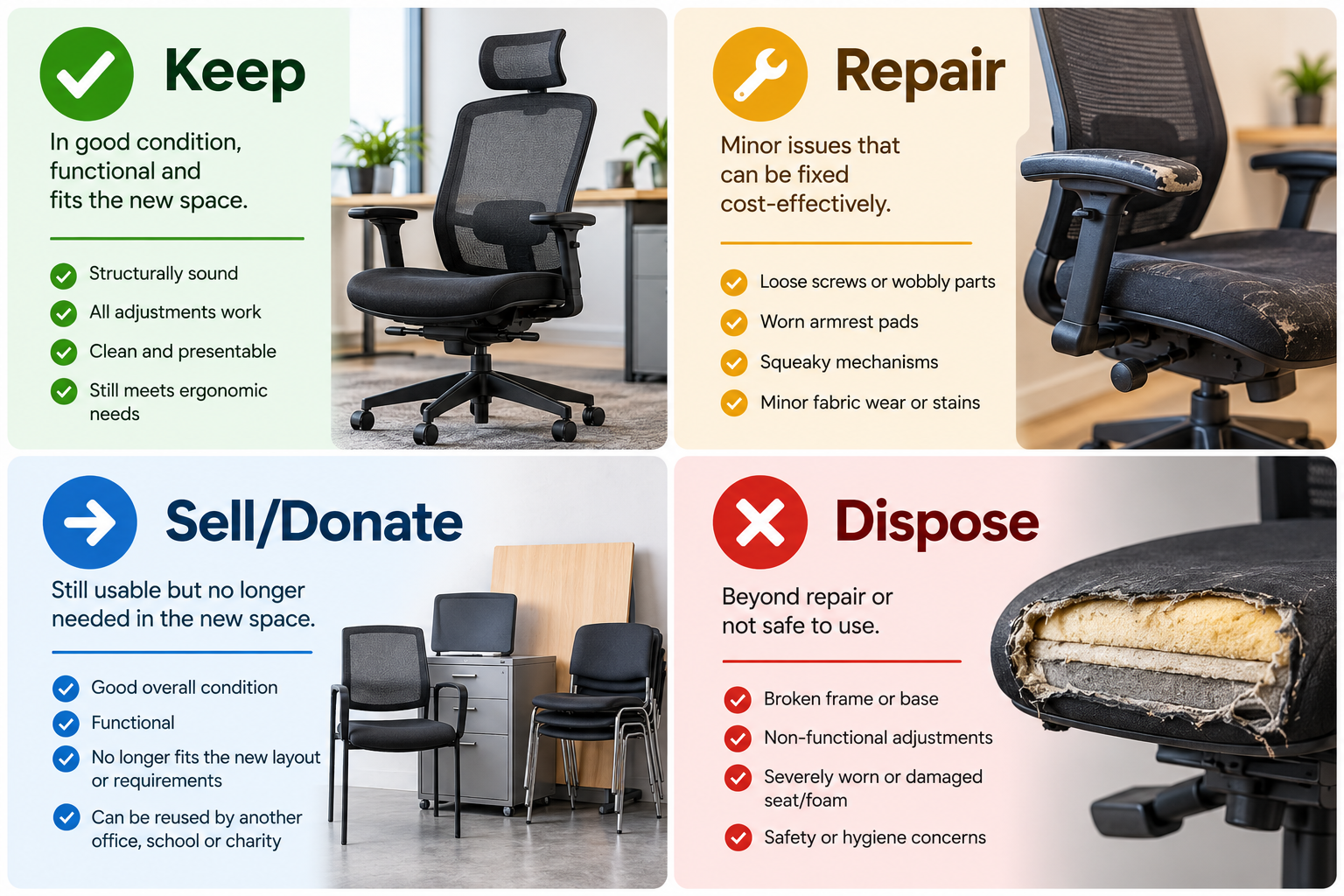
The audit framework: assign every piece of furniture one of four dispositions.
Keep: Structurally sound, fully functional, all adjustment mechanisms working. Worth the transport cost and the floor space in the new office.
Repair and move: Valuable item with a fixable issue - a seized tilt mechanism, worn armrest pads, a gas lift that needs replacing. Cheaper to repair than replace; worth doing before the move rather than in the new space.
Sell or donate: Functional but no longer needed - surplus chairs, storage units that won't fit the new floor plan, fixed desks being replaced with height-adjustable workstations.
Dispose: Foam-compressed seats that no longer distribute weight correctly, non-adjustable chairs with seized mechanisms, desks with structural damage. These are not ergonomically functional regardless of what they look like. Moving them means recreating the problems you're trying to leave behind.
The test for chairs specifically: sit in each one and adjust every mechanism. Does the gas lift hold height without sinking? Does the lumbar contact the L4-L5 region with both height and depth adjustment working? Does the seat foam support weight without compressing significantly? If three or more functions are compromised, the chair is not worth moving.
Step 2: Work From the New Floor Plan Backward
Specify furniture from the new floor plan backward - not from your existing inventory forward. The floor plan determines what fits, what zones are needed, and how many of each category you require. Furniture specified before the floor plan is confirmed creates expensive late changes.
What the floor plan tells you:
Room dimensions and clearances: Confirm ceiling height before ordering acoustic pods (most require 2.3–2.8m clearance). Measure every doorway, corridor, and lift that furniture must pass through - the diagonal depth of large items must clear the narrowest point on the delivery path.
Zone allocation: How much of the floor is individual workstation, collaborative, acoustic, and informal? This determines your desk count, pod count, and meeting table specification. See our complete workspace planning guide for zone ratio guidance.
Power outlet positions: Each electric standing desk requires one UAE standard 13A outlet near the desk base. Acoustic pods need a power source nearby. Confirm outlet positions before finalising workstation and pod placement - retrofitting power after furniture is in position adds cost and delay.
Natural light and AC coverage: In UAE offices, west-facing positions receive intense afternoon solar gain. Position monitor-facing workstations perpendicular to windows to prevent screen glare. Acoustic pods perform best in well-cooled zones - confirm AC coverage over intended pod positions before finalising placement.
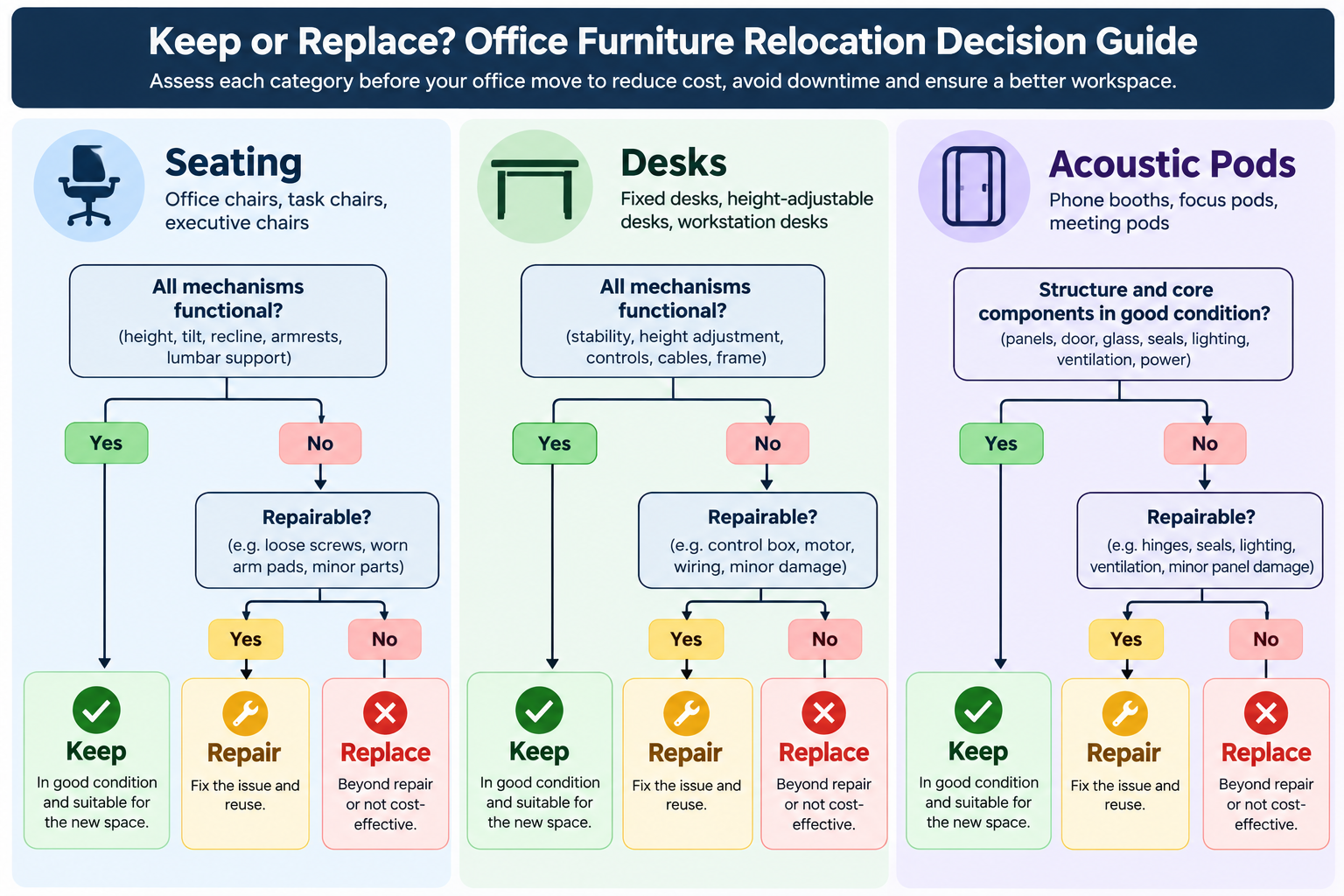
Step 3: The Keep vs Replace Decision by Category
Seating
Keep if: BIFMA-certified, all mechanisms functional, seat foam not compressed, less than 8 years old.
Replace if: foam compressed, lumbar adjustment not functioning, armrests seized, gas lift sinking during session.
The UAE climate adds a specific consideration: leather and foam chairs that have been in sustained use for 4+ years in AC-cooled offices often show accelerated foam compression at seat contact surfaces. Test every chair functionally, not visually.
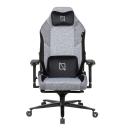
Replacement options from our ergonomic chairs range all verified adjustable, all suited to UAE working hours.
Desks and Workstations
Keep if: structurally sound, surface undamaged, and the height is correct for the user assigned to it in the new space.
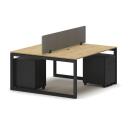
Replace if the new floor plan includes hot-desking or shared workstations - a fixed-height desk cannot ergonomically serve multiple users of different heights. A height-adjustable standing desk reaches every user's correct position.
The relocation is the moment to correct a desk height problem that was accepted as normal in the old office. Users who have been compensating for a desk 3–4cm too high will notice the difference within the first week at the correct height.
Acoustic Pods and Phone Booths
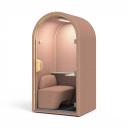
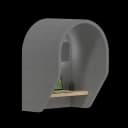
Always worth moving if in good condition - pods are freestanding furniture, not construction. They move with the same effort as a large desk. Our Navopod range and acoustic phone booths are designed for repositioning as office layouts evolve.
If the new office is larger or has a higher call volume environment, the relocation is the time to add units - not after move-in when the noise problem becomes visible.
Storage
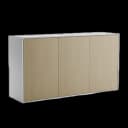
Keep if: lockable mechanisms work, structural integrity is intact, dimensions fit the new floor plan.
Replace if: the new space requires more or less storage than the old, or if regulated-industry document security requirements have changed.
Meeting Tables
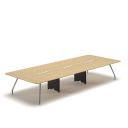
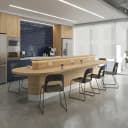
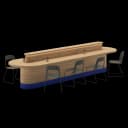
Keep if: dimensions suit the new meeting room sizes. A 300cm table that fitted a 5.5m × 5m room may not work in a 4m × 5m room in the new office - check clearances before assuming it comes with you.
Replace if: the new meeting spaces are different dimensions or the table aesthetic no longer fits the specification of the new space.
Step 4: Order Early - Lead Times Are Not Equal
The single most common reason teams work from boxes for two weeks after move-in: furniture was ordered after the fit-out contractor confirmed handover rather than during the construction phase.
Lead times by product category in the UAE market:
| Category | Standard Stock | Custom Finish / Large Volume |
|---|---|---|
| Ergonomic chairs | 1–2 weeks | 3–5 weeks |
| Electric standing desks | 2–3 weeks | 4–8 weeks |
| Acoustic pods | 2–4 weeks | 4–6 weeks |
| Meeting tables | 1–3 weeks | 4–8 weeks |
| Storage and accessories | 1–2 weeks | 2–4 weeks |
The rule: order furniture at the start of the construction phase, not at handover. It arrives as construction wraps. The team is operational on day one - not week three.
If the new office requires Dubai Municipality fit-out permits for partition works, the permit timeline (1–6 weeks depending on drawing quality) runs in parallel with furniture lead times when sequenced correctly. Sequenced incorrectly - permits first, then furniture order - adds weeks of an empty, rent-paying space.
Step 5: The Delivery Day Checklist
Before the furniture arrives:
☐ Floor finish confirmed - hard casters for tile/polished concrete; soft casters for carpet
☐ Lift dimensions verified - test-fit the largest item before delivery day
☐ Door and corridor clearances checked - diagonal depth of large items must clear every passage
☐ Power outlets confirmed at each workstation and pod position
☐ AC coverage confirmed at pod positions
☐ Building management notified of delivery schedule and loading bay requirements
☐ Team briefed on which items go where - a floor plan in the hands of every delivery crew member eliminates the "where does this go?" delays
After installation:
☐ Every chair mechanism tested at the assigned user's height
☐ Every desk height preset saved for the assigned user
☐ Every monitor arm adjusted to eye level at both sitting and standing heights
☐ Cable management routing tested through full standing desk height range
☐ Pod power and ventilation confirmed operational
The Relocation Reset: What to Fix This Time
Every ergonomic problem your team accepted as normal in the old office exists because fixing it required disruption. The relocation creates the disruption anyway. Use it.
Correct desk heights: If any team members have been compensating for a desk at the wrong height - shoulders elevated, neck bent, wrists extended - the relocation is when you fix it. A height-adjustable desk ordered to the correct specifications requires no further disruption to the team.
Add acoustic separation: If the old office had a meeting room perpetually booked for individual calls, the noise problem follows you to the new space unless you address it in the specification. Office pods and phone booths specified in the new floor plan from the start are better positioned and cheaper than retrofitting after move-in.
Upgrade seating: If chairs were functional enough not to justify replacement in the old office but were producing back pain complaints, the relocation budget is the right moment. Moving non-ergonomic chairs to a new space doesn't fix what's wrong with them.
Need Help Building Your Ergonomic Setup?
We'll guide you to the perfect chair, desk setup, and comfort tips for a productive workday.
Shop Office FurniturePopular Blogs
View all
Ergonomic Furniture Meets Gaming & Education: Highlights from the University of Wollongong Event
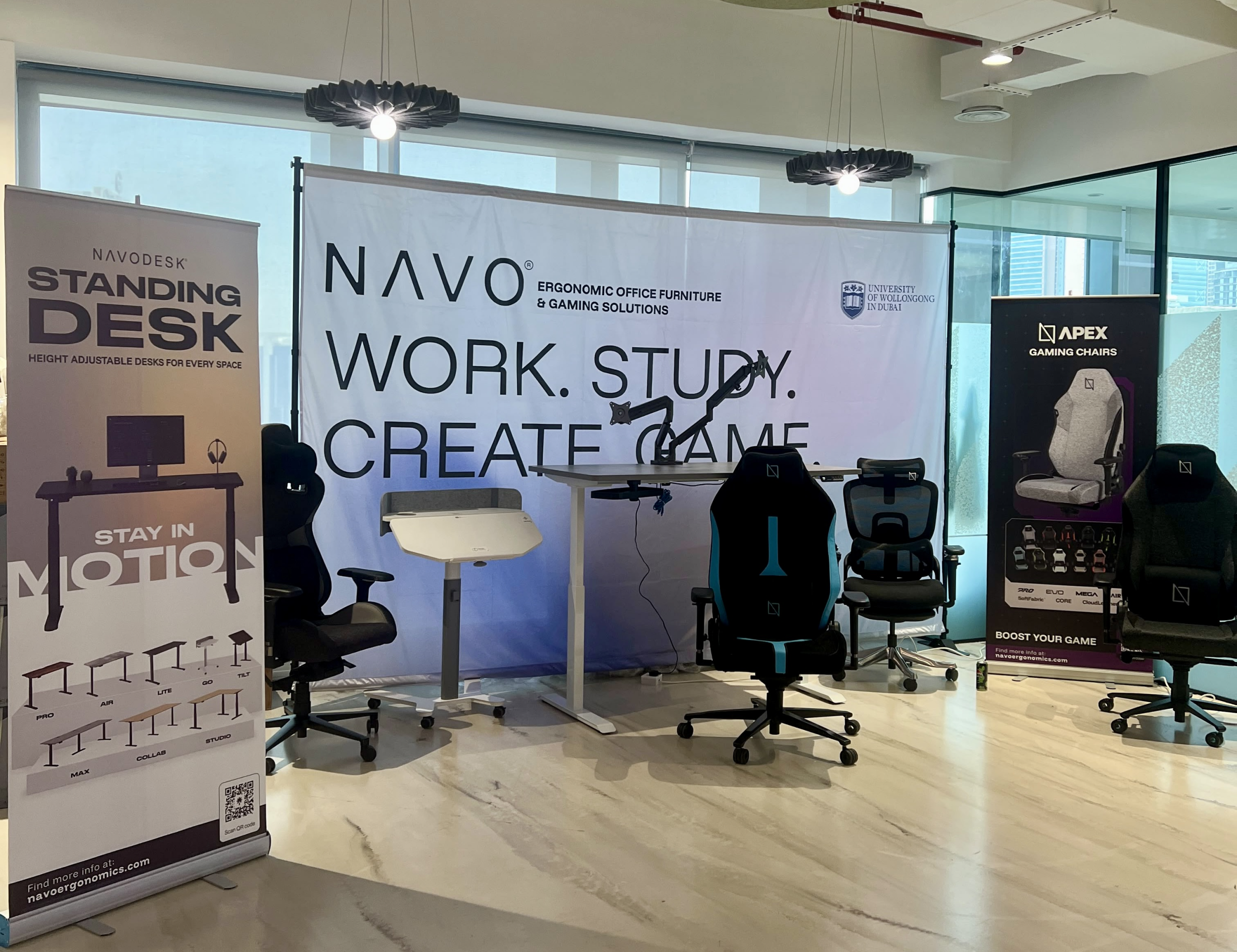
The tournament attracted over 70 participants, including avid gamers and curious onlookers. Our display featured gaming desks, chairs, and ergonomic accessories such as monitor arms. Students could compete in exciting gaming matches while experiencing our products firsthand.

One of the event's highlights was the opportunity to experience our ergonomic gaming chairs alongside our specially designed ergonomic chairs. Students could compare their comfort, support, and overall seating experience. The feedback was overwhelmingly positive, with many participants noticing differences in posture support and comfort during extended use.
Looking back, we are encouraged by the positive interactions and insights shared by students and faculty. Promoting ergonomic awareness in university environments is a cause we strongly support, and we look forward to continuing our efforts to help create more comfortable and productive spaces for learning, gaming, and work.
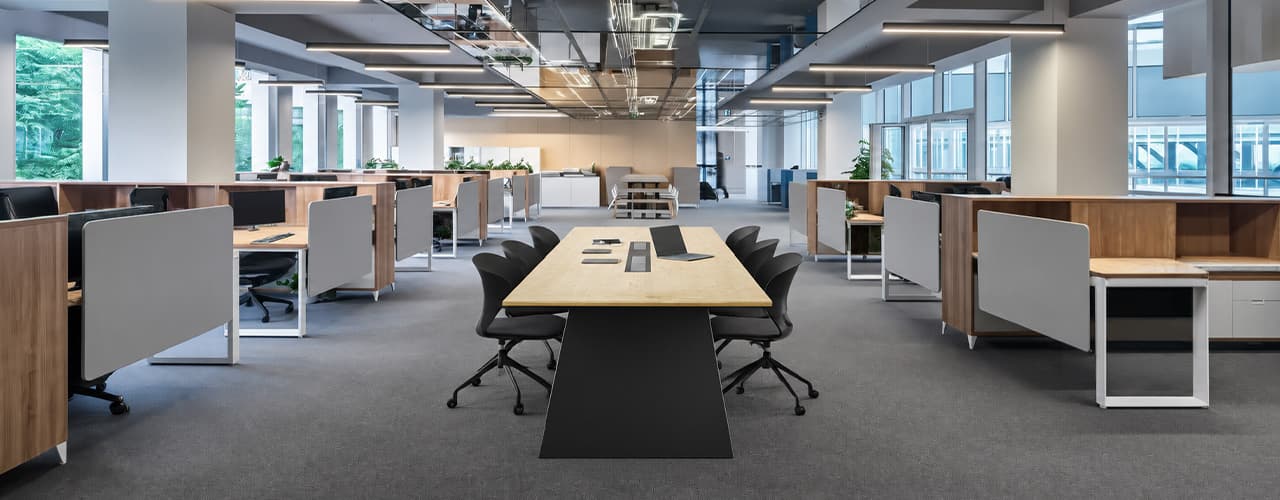
Open Plan vs Cubicle vs Hybrid Office Layout: Which Is Right for You?
The open-plan office was supposed to fix everything the cubicle farm got wrong. It didn't. It created a different set of problems and left people nostalgic for the one thing cubicles did well: quiet. The hybrid layout is positioned as the solution that addresses the shortcomings of both. It might be only if it fits how a specific team works. It shouldn't be a mix of two philosophies that didn’t help the team before. This guide shows what each layout offers and where it falls short. It also helps you choose the best option-or combination-for your office in Dubai or the GCC.
Key Findings
*Global office use is now at 53%, up from 38% in 2024. Also, 69% of teams have over 40% of their staff sharing desks. This shows that 2019 workspace designs don’t fit current needs.
*A Harvard study found that open-plan spaces often lower face-to-face interaction. Instead, they boost digital communication. This is the opposite of what these designs aim for.
*A hybrid model conversion at a 120-person SaaS company restored engineering deployment speed to baseline. It also reduced voluntary turnover in technical roles by 18% over nine months.
*Steelcase research shows that companies improving their work environment boost productivity by 17%.
*In 2026, the most innovative UAE offices aren’t just picking open plans or cubicles. They’re creating “activity neighborhoods.” These are clusters of spaces designed for different work styles.
*No layout is universally right. The best choice depends on your team's work style, industry, hybrid attendance ratio, and specific acoustic needs for your floor.
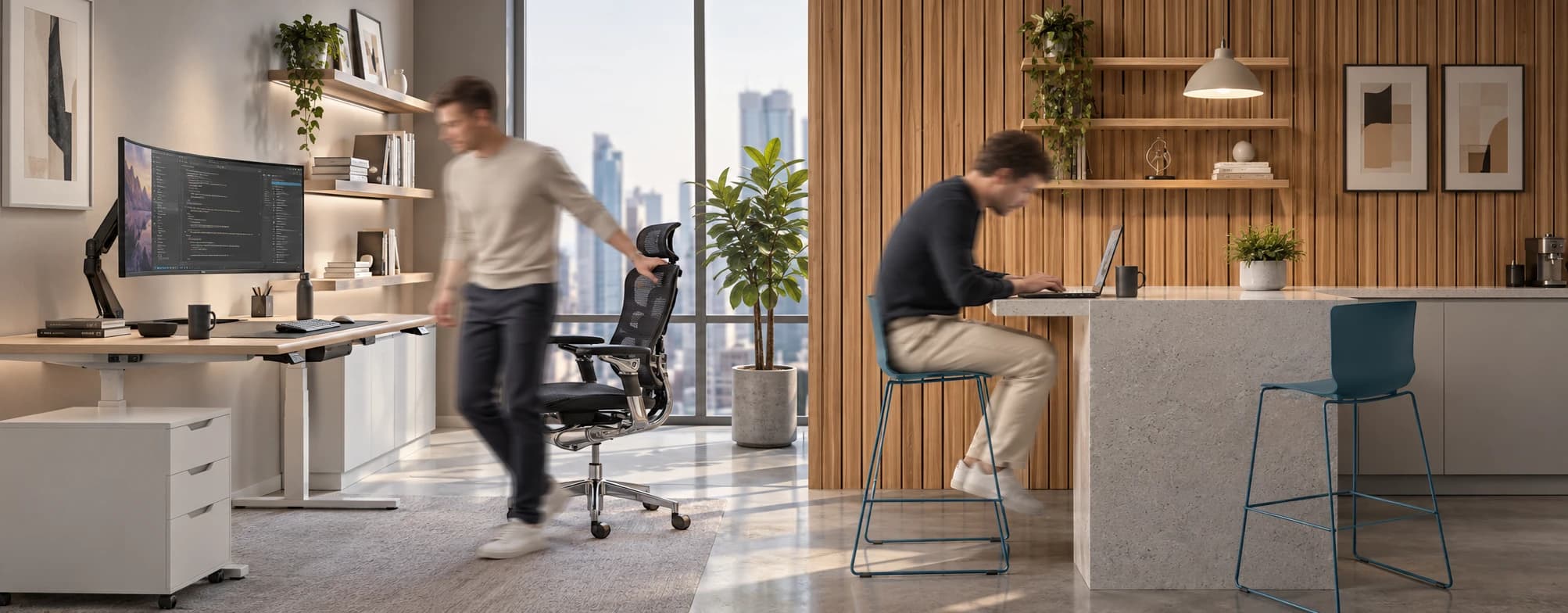
Sitting isn’t the Enemy, How You Sit Is: How to Align Your Desk for Zero Back Strain
If your job keeps you at a desk for most of the day, you are not alone—and you are not stuck. Software developers and data entry keyers spend 100% of a typical workday seated, while financial managers sit for 94%. Sitting is a standard part of modern work, so the real goal is learning how to reduce its physical impact while staying productive.
What the Research Shows
*Sedentary Volume: Adults in high-income countries spend 11–12 hours daily sitting over 75% of their waking hours (British Journal of Sports Medicine).
*Cardiovascular Risks: Sitting 6–8 hours daily increases cardiovascular event risk by 125% to 150% (Mayo Clinic).
*The 22-Minute Counter: 22 minutes of daily moderate-to-vigorous activity (brisk walking, cycling, active housework) offsets the mortality risk of prolonged sitting (BJSM).
*Micro-Break Impact: 5-minute movement breaks every hour significantly reduce fatigue and improve mood without hurting work performance (2026 BJSM Study).
*Gym Fallacy: A 60-minute workout in the morning does not fully reverse 9 hours of continuous sitting; daily movement breaks are still required.
You x Navo
Feel free to reach out to us for any queries & concerns