

 Visit our Showroom
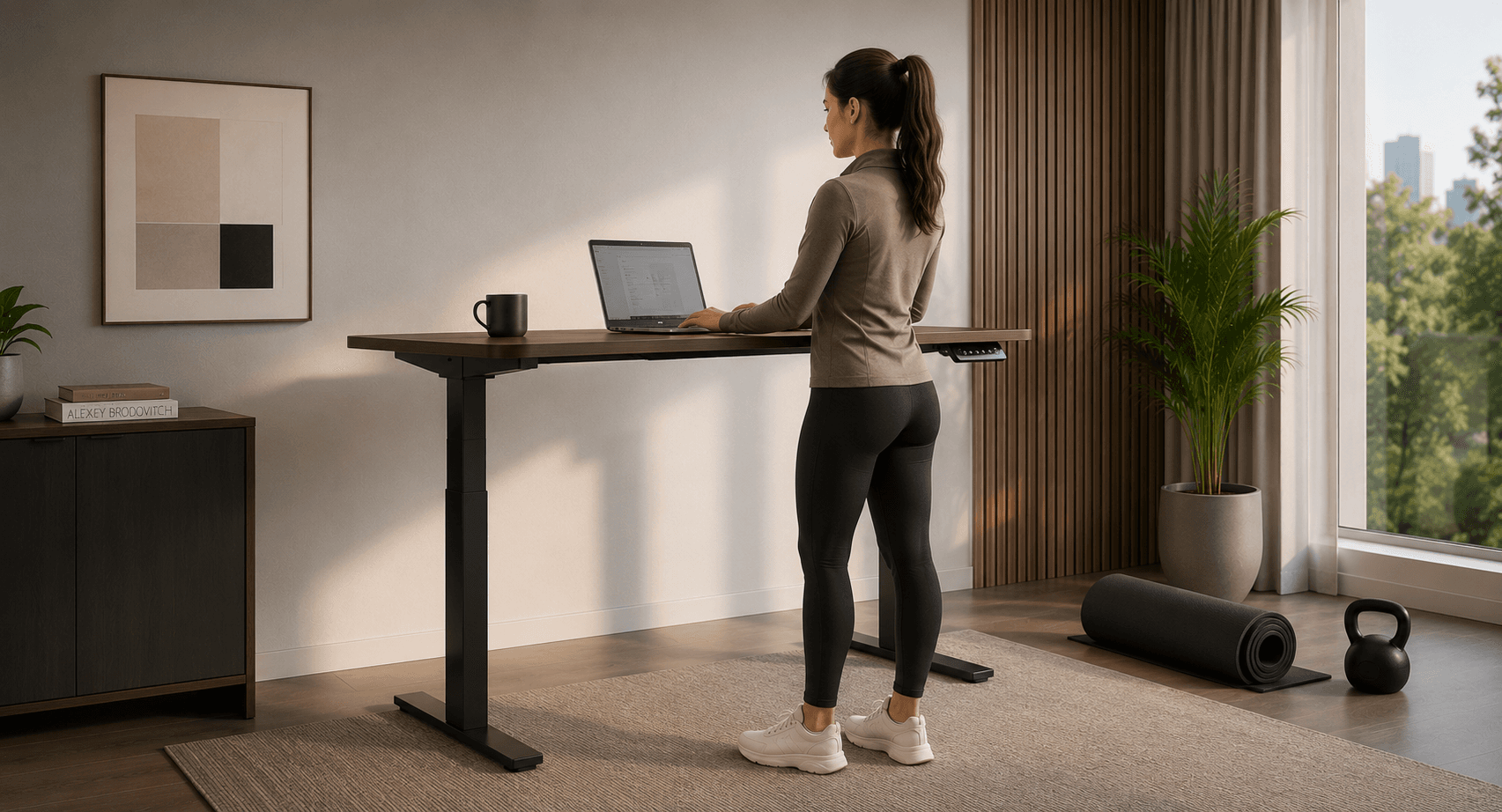
The marketing is tempting: stand at your desk, burn more calories, lose weight without going to the gym. It's the kind of claim that sells standing desks to people who otherwise wouldn't buy them.
Here's the honest version - backed by sources, not slogans.
Take me to
Do Standing Desks Actually Burn More Calories Than Sitting?
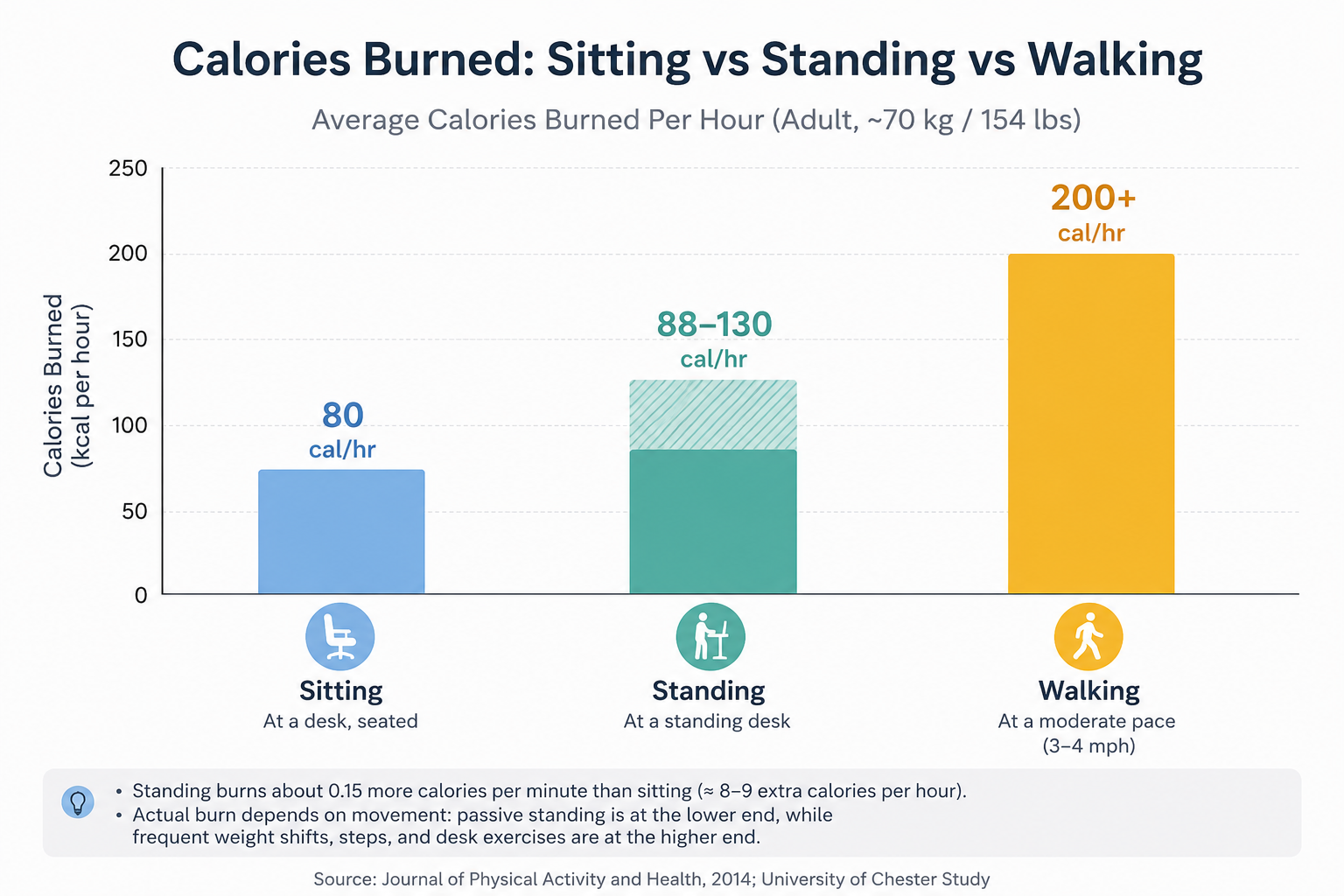
Yes - but the difference is smaller than most people expect. Research in the Journal of Physical Activity and Health found that standing burns about 0.15 more calories per minute than sitting. That’s around 8 to 9 extra calories each hour. Over three hours of standing daily, that's around 24–27 additional calories, roughly equivalent to one bite of an apple.
A University of Chester study found that participants who stood for 3 hours burned about 144 more calories than those who sat. This better number shows the advantages of moving while standing, not just staying still.
The range in the research (8–50 extra calories per hour) reflects a meaningful variable: what you actually do while standing. Passive standing (arms at sides, minimal movement) is at the lower end. Standing with frequent weight shifts, small steps, and desk exercises is at the higher end.
The point is: standing itself is not the calorie-burning mechanism most people assume.
Can a Standing Desk Help You Lose Weight Over Time?
Over months and years: modestly yes - but not through standing itself. The mechanism is NEAT (Non-Exercise Activity Thermogenesis). Users of standing desks often move more during the day. They shift their weight, take short walks, and do calf raises. This extra movement burns more calories beyond just using the desk.
Harvard Health shared a clear assessment: a standing desk probably won’t help you lose weight or stop weight gain just by burning calories. Research shows that standing for 4 hours a day burns about 160 extra calories. That’s just a bit less than a handful of nuts.
A review in Applied Ergonomics found that sit-stand desks encourage more movement. People walk to the printer, pace during calls, and take stretch breaks. This creates more cumulative movement than seated workers achieve.
Standing desks help manage weight. They reduce the long hours of inactivity caused by sitting. They don't burn fat. They disrupt the fat metabolism slowdown caused by prolonged sitting. Research in Circulation shows this is linked to higher cardiovascular and metabolic risks over time.
That's a meaningful health benefit. It's just not the same as losing weight.
What Does NEAT Mean and Why Does It Matter More Than Calories?
NEAT (Non-Exercise Activity Thermogenesis) is the energy you burn when you're not formally exercising. This means activities like walking to meetings, fidgeting, standing, and making coffee. Research from the Mayo Clinic shows that NEAT can differ by as much as 2,000 calories each day among people with similar body weights. This makes NEAT a bigger factor in weight management than formal exercise for many.
Standing desks contribute to NEAT by creating conditions for more movement — not by replacing movement. A sedentary person who buys a standing desk and stands for 4 hours does not burn many calories. A person who stands, walks while talking, and stretches often builds up significant daily NEAT.
The desk creates opportunity. Behaviour determines outcomes.
This is why how long you stand matters. Regular intervals of standing and moving create more NEAT than long periods of just standing still.
What Are the Real Health Benefits of Standing Desks If Not Weight Loss?
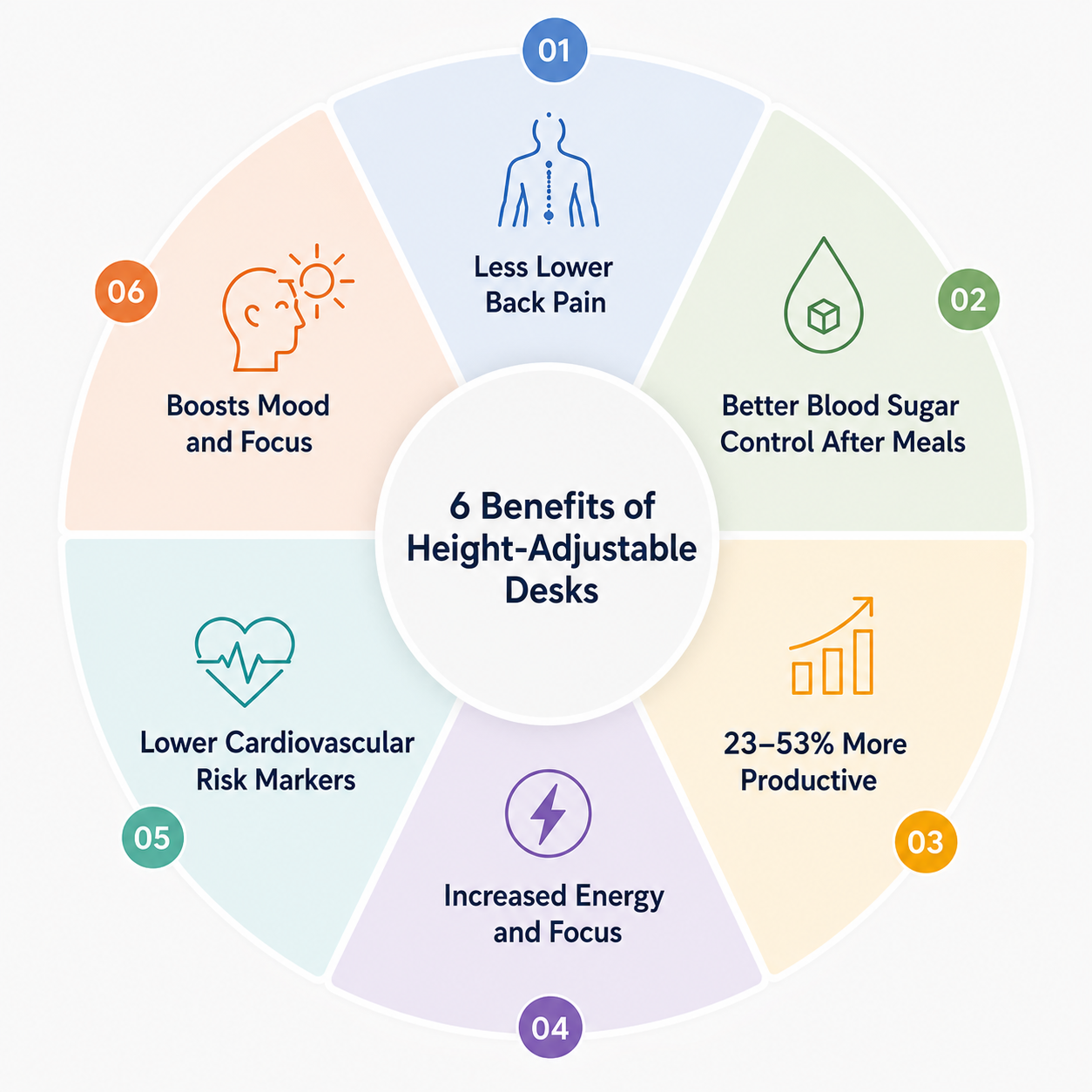
Research in The British Journal of Sports Medicine shows that regularly switching between sitting and standing offers several benefits. These include:
Less lower back pain
Better blood sugar control after meals
Lower cardiovascular risk markers
Increased energy and focus in the afternoon
Reduced risk of musculoskeletal disorders
A 2025 review highlighted a Texas A&M study. It found that standing desk users were 23–53% more productive than those sitting. This boost in productivity came from more energy and less afternoon fatigue, not from burning calories.
The Cleveland Clinic highlights that standing desks boost mood and focus. This is especially true in the afternoon, when workers often feel tired from sitting too long. A 2022 study showed that fatigue improved somewhat, leading to more tasks being completed.
Here are the reasons to consider height-adjustable desks. They aren't effective for weight loss, so forget the calorie math.
What Actually Burns More Calories at a Standing Desk?
Active movement during standing burns meaningfully more than passive standing. Walking burns about 200+ calories per hour. In comparison, standing burns only 88–130 calories.
The best ways to burn calories at your desk are:
Walking while taking calls
Doing desk calf raises when standing
Taking 2-minute movement breaks every 30 minutes
Movement additions to standing desk use:
Walking calls: Take every non-video phone call walking. 20 minutes of walking calls daily adds approximately 70 calories — nearly 3× the standing desk calorie benefit in less time.
Calf raises during standing: Activates large lower leg muscles continuously. 50 calf raises per standing session takes 2 minutes and burns 10–15 additional calories while improving venous return.
2-minute movement breaks: Every 30 minutes — walk to kitchen, take stairs, brief corridor walk. Adds NEAT without impacting work.
The desk enables these behaviours more naturally than a fixed seated workstation. That's the accurate mechanism.
To pair these habits with your workspace, check out our guide on desk stretches and microbreaks. It shows the best movement patterns for using a standing desk.
The Navodesk PRO's Bluetooth app tracks your activity time. It also sends movement reminders. These features help you build habits that burn calories.
What Should You Actually Expect from a Standing Desk?
Realistic outcome of consistent sit-stand desk use over 12 months: 100–200 daily calorie increase if combined with active movement habits, metabolic health improvements from reduced prolonged sitting, and meaningful reductions in afternoon fatigue and musculoskeletal discomfort. Unrealistic expectation: significant weight loss without dietary changes or exercise.
As Medical News Today summarises from a review in Applied Ergonomics: "There are health benefits to using sit-stand desks, such as a small decrease in blood pressure or low back pain relief, but people simply are not yet burning enough calories to lose weight with these devices."
The right framing: a standing desk is a long-term metabolic health tool, not a weight loss shortcut.
Frequently Asked Questions
- Approximately 24–160 additional calories depending on standing duration and movement during standing periods. Standing passively for 3 hours: ~27 extra calories. Standing actively with movement for 4 hours: ~100–160 extra calories. Source: Journal of Physical Activity and Health.
- No. The World Health Organisation explicitly states that strategies to reduce sedentary time do not replace the recommended 150–300 minutes of moderate physical activity per week. Standing desks reduce sedentary risk; they don't generate fitness benefit.
- No direct evidence supports targeted fat reduction from standing. The metabolic benefit is reduced sedentary behaviour — which is linked to lower metabolic disease risk over time, not active fat burning.
- According to a British Journal of Sports Medicine review, reduced sitting time (by 84–116 minutes daily in sit-stand desk users) correlates with lower back pain reduction, improved blood glucose regulation, and reduced cardiovascular risk markers. These benefits are well-documented; weight loss is not.
Need Help Building Your Ergonomic Setup?
We'll guide you to the perfect chair, desk setup, and comfort tips for a productive workday.
Shop Office FurniturePopular Blogs
View all
Ergonomic Furniture Meets Gaming & Education: Highlights from the University of Wollongong Event
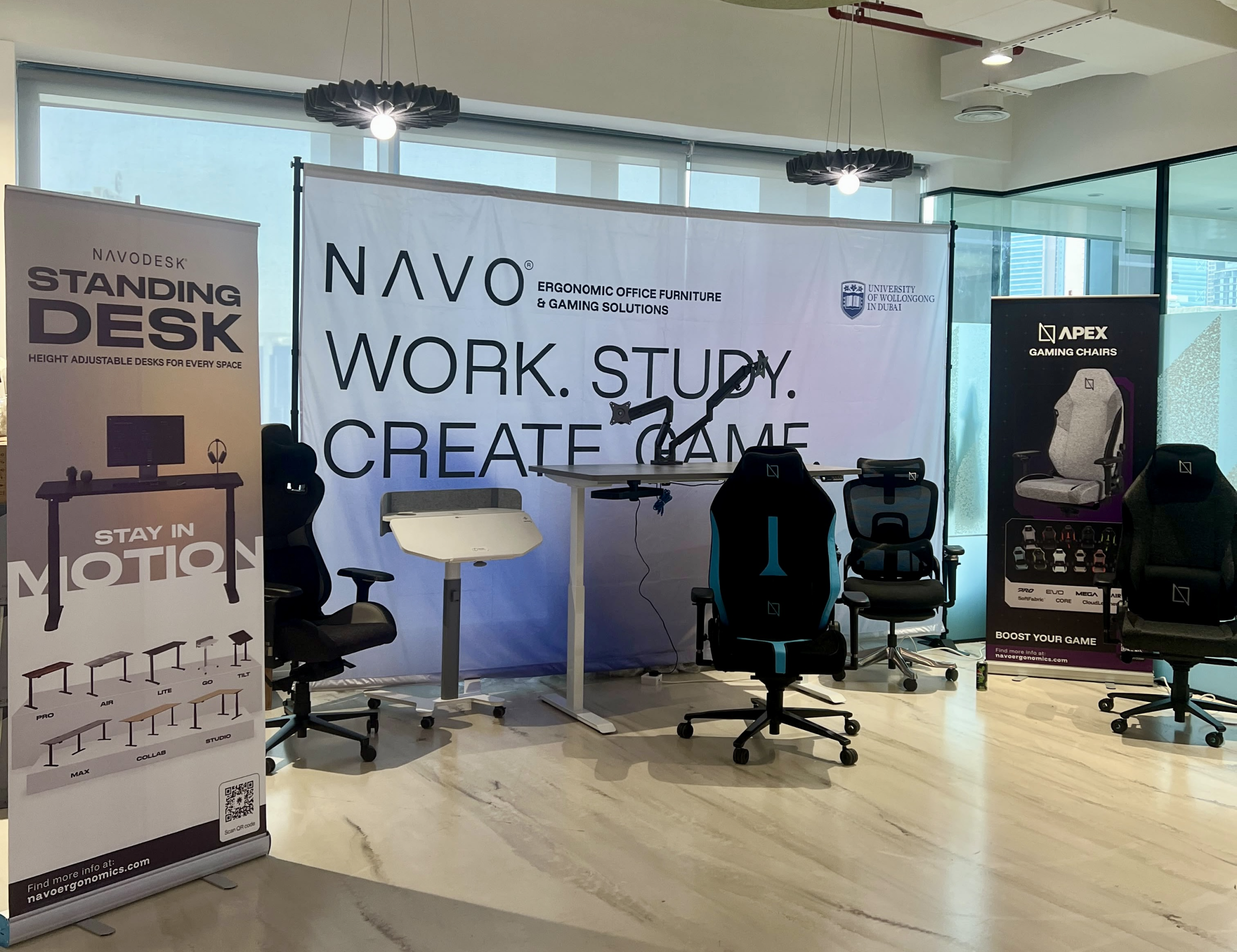
The tournament attracted over 70 participants, including avid gamers and curious onlookers. Our display featured gaming desks, chairs, and ergonomic accessories such as monitor arms. Students could compete in exciting gaming matches while experiencing our products firsthand.
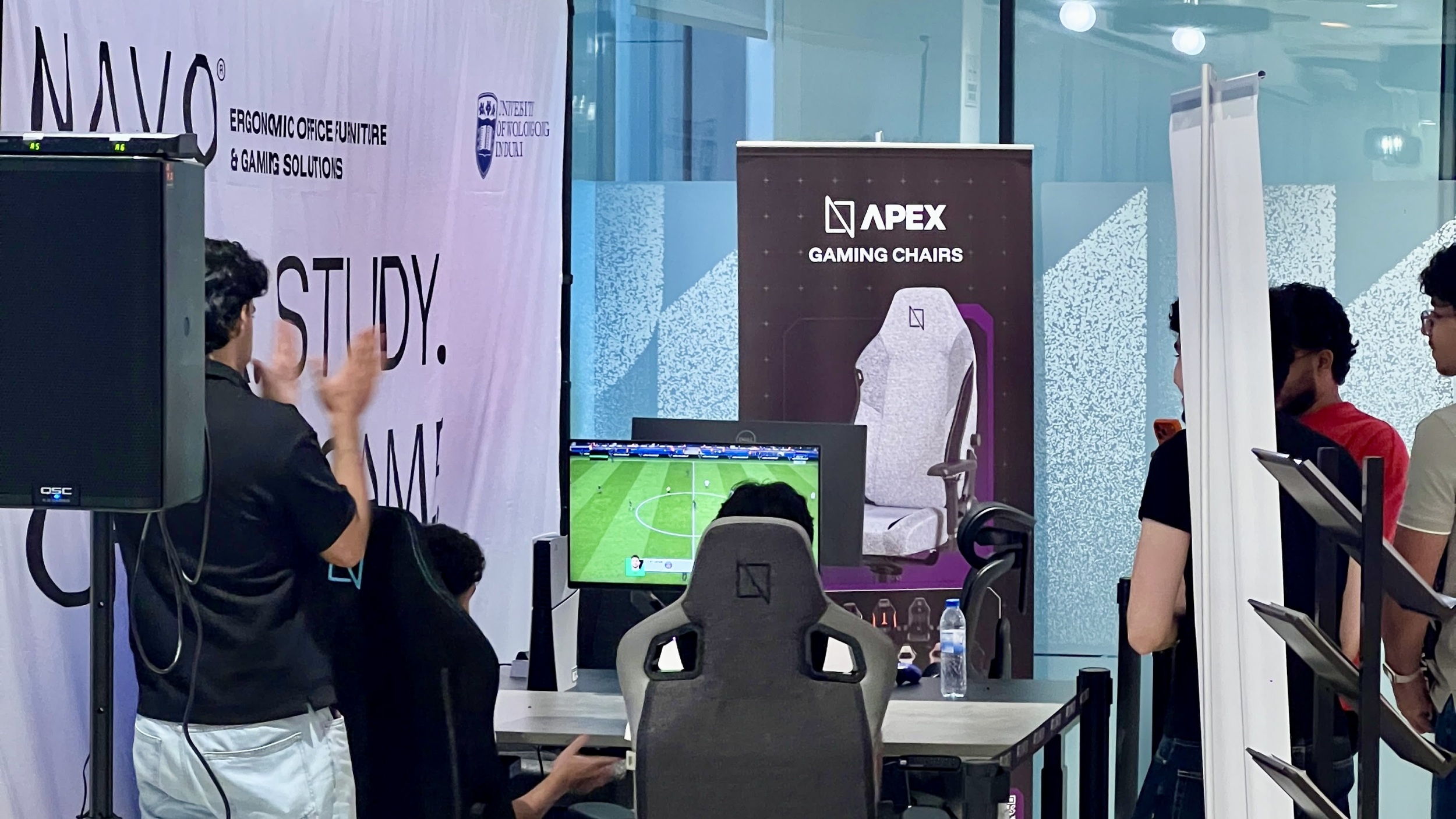
One of the event's highlights was the opportunity to experience our ergonomic gaming chairs alongside our specially designed ergonomic chairs. Students could compare their comfort, support, and overall seating experience. The feedback was overwhelmingly positive, with many participants noticing differences in posture support and comfort during extended use.
Looking back, we are encouraged by the positive interactions and insights shared by students and faculty. Promoting ergonomic awareness in university environments is a cause we strongly support, and we look forward to continuing our efforts to help create more comfortable and productive spaces for learning, gaming, and work.
Open Plan vs Cubicle vs Hybrid Office Layout: Which Is Right for You?
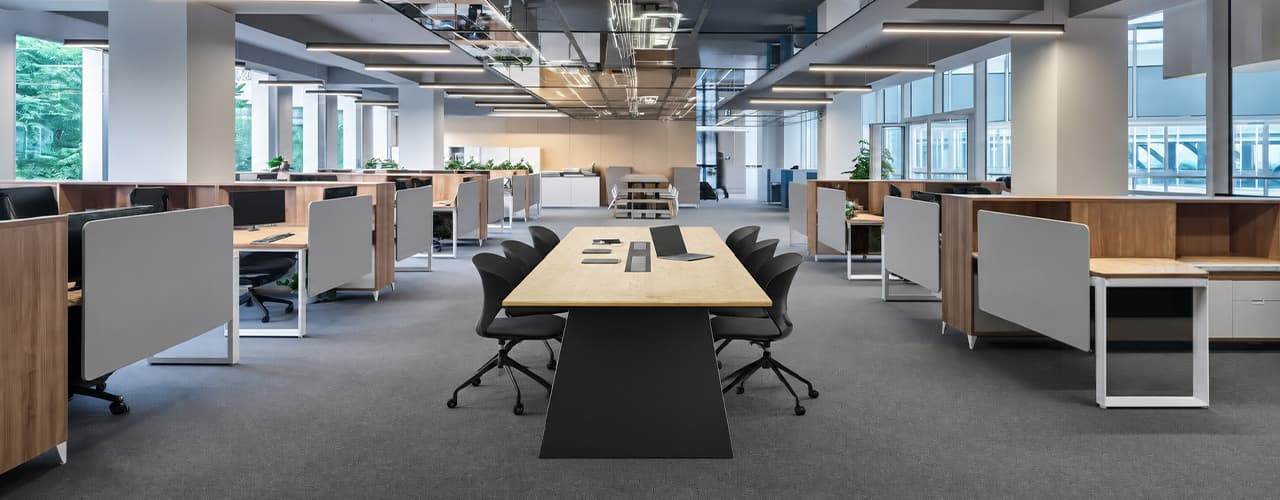
The open-plan office was supposed to fix everything the cubicle farm got wrong. It didn't. It created a different set of problems and left people nostalgic for the one thing cubicles did well: quiet. The hybrid layout is positioned as the solution that addresses the shortcomings of both. It might be only if it fits how a specific team works. It shouldn't be a mix of two philosophies that didn’t help the team before. This guide shows what each layout offers and where it falls short. It also helps you choose the best option-or combination-for your office in Dubai or the GCC.
Key Findings
*Global office use is now at 53%, up from 38% in 2024. Also, 69% of teams have over 40% of their staff sharing desks. This shows that 2019 workspace designs don’t fit current needs.
*A Harvard study found that open-plan spaces often lower face-to-face interaction. Instead, they boost digital communication. This is the opposite of what these designs aim for.
*A hybrid model conversion at a 120-person SaaS company restored engineering deployment speed to baseline. It also reduced voluntary turnover in technical roles by 18% over nine months.
*Steelcase research shows that companies improving their work environment boost productivity by 17%.
*In 2026, the most innovative UAE offices aren’t just picking open plans or cubicles. They’re creating “activity neighborhoods.” These are clusters of spaces designed for different work styles.
*No layout is universally right. The best choice depends on your team's work style, industry, hybrid attendance ratio, and specific acoustic needs for your floor.
Sitting isn’t the Enemy, How You Sit Is: How to Align Your Desk for Zero Back Strain
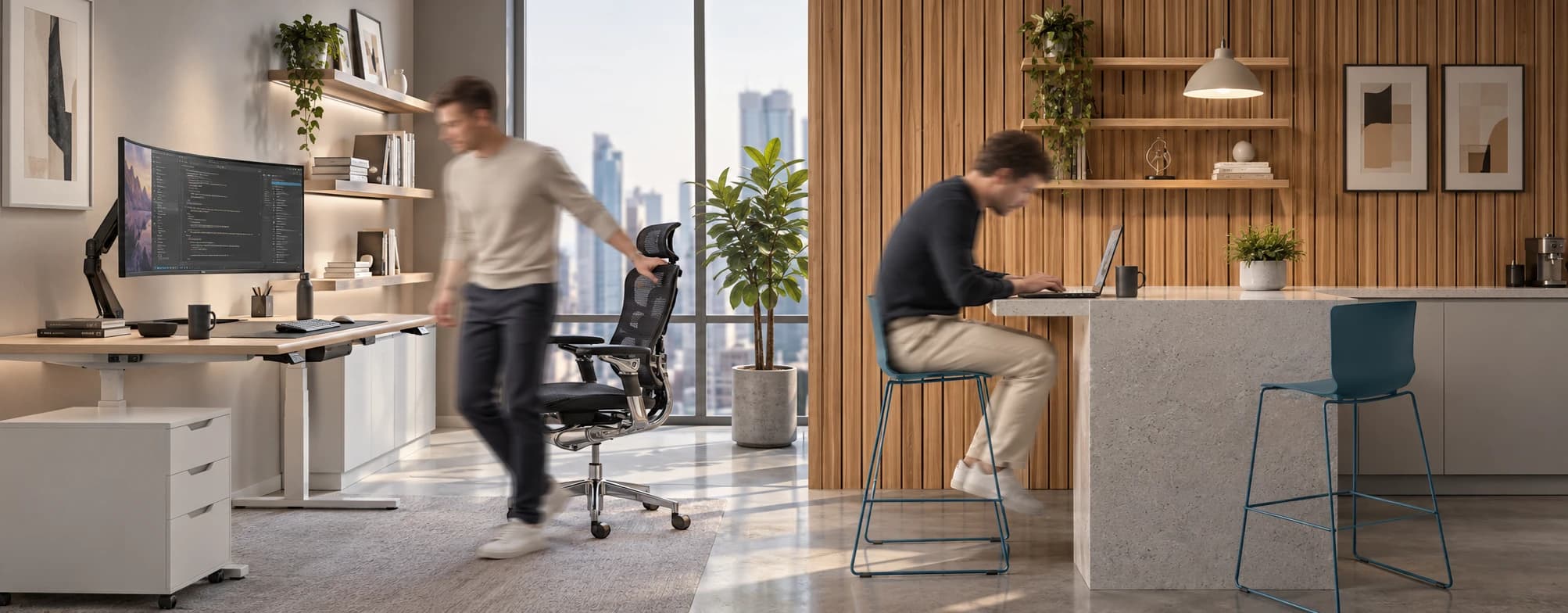
If your job keeps you at a desk for most of the day, you are not alone—and you are not stuck. Software developers and data entry keyers spend 100% of a typical workday seated, while financial managers sit for 94%. Sitting is a standard part of modern work, so the real goal is learning how to reduce its physical impact while staying productive.
What the Research Shows
*Sedentary Volume: Adults in high-income countries spend 11–12 hours daily sitting over 75% of their waking hours (British Journal of Sports Medicine).
*Cardiovascular Risks: Sitting 6–8 hours daily increases cardiovascular event risk by 125% to 150% (Mayo Clinic).
*The 22-Minute Counter: 22 minutes of daily moderate-to-vigorous activity (brisk walking, cycling, active housework) offsets the mortality risk of prolonged sitting (BJSM).
*Micro-Break Impact: 5-minute movement breaks every hour significantly reduce fatigue and improve mood without hurting work performance (2026 BJSM Study).
*Gym Fallacy: A 60-minute workout in the morning does not fully reverse 9 hours of continuous sitting; daily movement breaks are still required.
You x Navo
Feel free to reach out to us for any queries & concerns